

Why learn about ancient rituals? Why fast in the wilderness? We live in a world in which people constantly feel lost. The reasons are manifold: digitalization, economic crises, war, personal tragedy, physical and mental illness, demographic change…. Many are also struggling with a luxurious problem: They are facing too many options. They know, they could do so much, but they end up doing nothing because they are constantly afraid of choosing the wrong thing. On top of everything, the world appears to be becoming more diverse, more tolerant, more open-minded. At the same time, the Insta and TikTok world leads to more social pressure and conformity. And the bottom line? People, including the young generation, are full of fear, frustration, hopelessness, and a lack of motivation to turn all these fascinating opportunities into lived experiences.
“I wish I’d had the courage to live a life true to myself, not the life others expected of me.” (Ware, Bronnie. The Top Five Regrets of the Dying.)
Who is hungry of living? The question of how to live a good life, a fulfilled life, a meaningful life is as modern as it has ever been. It is an individual responsibility. And it is at the core of any spiritual tradition – whether you believe in Jesus, Buddha, Allah, or any other religious or non-religious path. We are all facing this question of meaning at some point; some earlier in life, some later. And this is exactly where the mission starts: Empowering people in their societies to follow their inner voice, to hear the call of their inner purpose, and to create a space for them to act and unfold their talents…
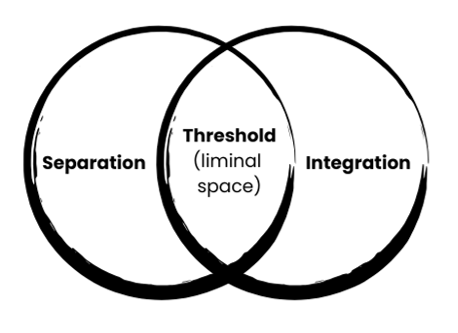
While the question of meaning is encoded in human DNA, the way in which we try to find answers has changed significantly. We ask ChatGPT, we do therapy, we hire coaches, maybe we even go to church again because God might be the last resort. Whatever helps, is fine. Rites of Passage and other ancient practices show us alternative pathways to dealing with the question of purpose, the question of loss, and the question of moving on. It is not an either/or – it is a both/and approach. For individuals who are dying to live, who feel they are wasting their lives, or who actually think about dying by taking their lives due to trauma, loss, or illness – learning about ancient practices of life transitions is liberating. It can open doors to a new future. The same applies to institutions that are stuck or struggling. How often do you hear managers say: “We need a strategy. We need someone to tell us where to go.” No! Ask yourself who you are first. This will help you find out who you want to be in the future. Only you can answer this. And this will show you the next step. And then it is your task to walk it.
The mission behind this project is simple. Even though I know, people are suspicious when they hear the word mission. “Missionaries” proselytize, lecture, they represent dogma. Fine. I give you an alternative. I do think that the world still needs missionaries, just not in the way that most people think about them. I am not talking about religious lunatics who go out into the world, waving with a Bible in their hand, indoctrinating people with what they should believe, while otherwise threatening them with hell. The truth is, there have always been missionaries of a different kind. They truly help people find their way. They offer something that gives them orientation in the middle of nowhere. Something to hold on to. Something to trust in. Something to hope for. Seeking a companion on that journey is just as human as the fear of change and death. And this is also why I believe that the world still needs missionaries who act as change agents in the modern digital world.
"No one wants to die. Even people who want to go to heaven don't want to die to get there. And yet, death is the destination we all share. No one has ever escaped it, and that is how it should be, because death is very likely the single best invention of life. It's life's change agent. It clears out the old to make way for the new.” (Steve Jobs)
In the past, pastors took that role in church (and some of them still do). Nowadays, online gurus, life coaches, business consultants, and change managers have taken their place. There is something that connects all of them. The bad ones – sorry if you feel pissed off now – tell people what to do. The good ones ask questions and help people find their own answers. They assure them that one does not need to have all the answers at one time. They also help them understand that there are no universal “right” answers but individual ones for everyone. And above all, they encourage them to listen to their inner questions and voice them – about their own lives and about the way in which the world around them operates. These people often end up as troublemakers, rebels, and outcasts. The labels do not matter. The consequence often is that these people who have the natural talent to initiate change by questioning the status often end up losing themselves if they do not find support in others and in themselves.
dying to live is meant to empower these change agents… by providing knowledge, inspiration, and a platform for dialogue, projects, and implementation tools…
“Here's to the crazy ones. The misfits. The rebels. The troublemakers. The round pegs in the square holes. The ones who see things differently. They're not fond of rules. And they have no respect for the status quo. You can quote them, disagree with them, glorify or vilify them. About the only thing you can't do is ignore them. Because they change things. They push the human race forward. And while some may see them as the crazy ones, we see genius. Because the people who are crazy enough to think they can change the world, are the ones who do.” (Steve Jobs)